Every business we’ve ever worked with started the same way. Someone signed up for a CRM because it was the fastest way to stop losing leads in email threads. Someone else grabbed a project management tool because the spreadsheet had gotten out of hand. None of it was a bad decision at the time. It rarely is.
The problem shows up two or three years later, when you’ve got six tools running your business, half of them fighting each other, and a team that’s quietly built its own workarounds just to get through the week. Nobody planned for this. It just accumulates, the way clutter does, until one day someone asks “why does it take four people to close one deal?” and nobody has a good answer.
That’s usually the moment a business is ready to talk about custom software. Not because off-the-shelf tools are bad — they’re not, they’re genuinely useful for a lot of businesses — but because at a certain size and complexity, generic software starts costing you more than it saves. We’ve built software for companies across the US, UK, and Middle East who hit that exact wall, and the pattern is almost always the same.
What “Custom Software” Actually Means (Beyond the Buzzword)
Strip away the marketing language and custom software development is just this: building something that fits how your business actually runs, instead of asking your business to bend around whatever a vendor decided most companies need.
Sometimes that’s a CRM shaped around your real sales process instead of a generic pipeline. Sometimes it’s an internal tool that replaces the four spreadsheets someone’s been quietly maintaining. Sometimes it’s a full customer-facing platform, or a SaaS product you’re planning to sell to other businesses entirely. The shape changes. What doesn’t change is who it’s built for — one business, with its specific quirks, not the average of ten thousand businesses that bought the same off-the-shelf license.
That’s also the honest tradeoff. Off-the-shelf software is designed to be good enough for almost everyone. Custom software is designed to be exactly right for one.
Where the Real Cost Hides
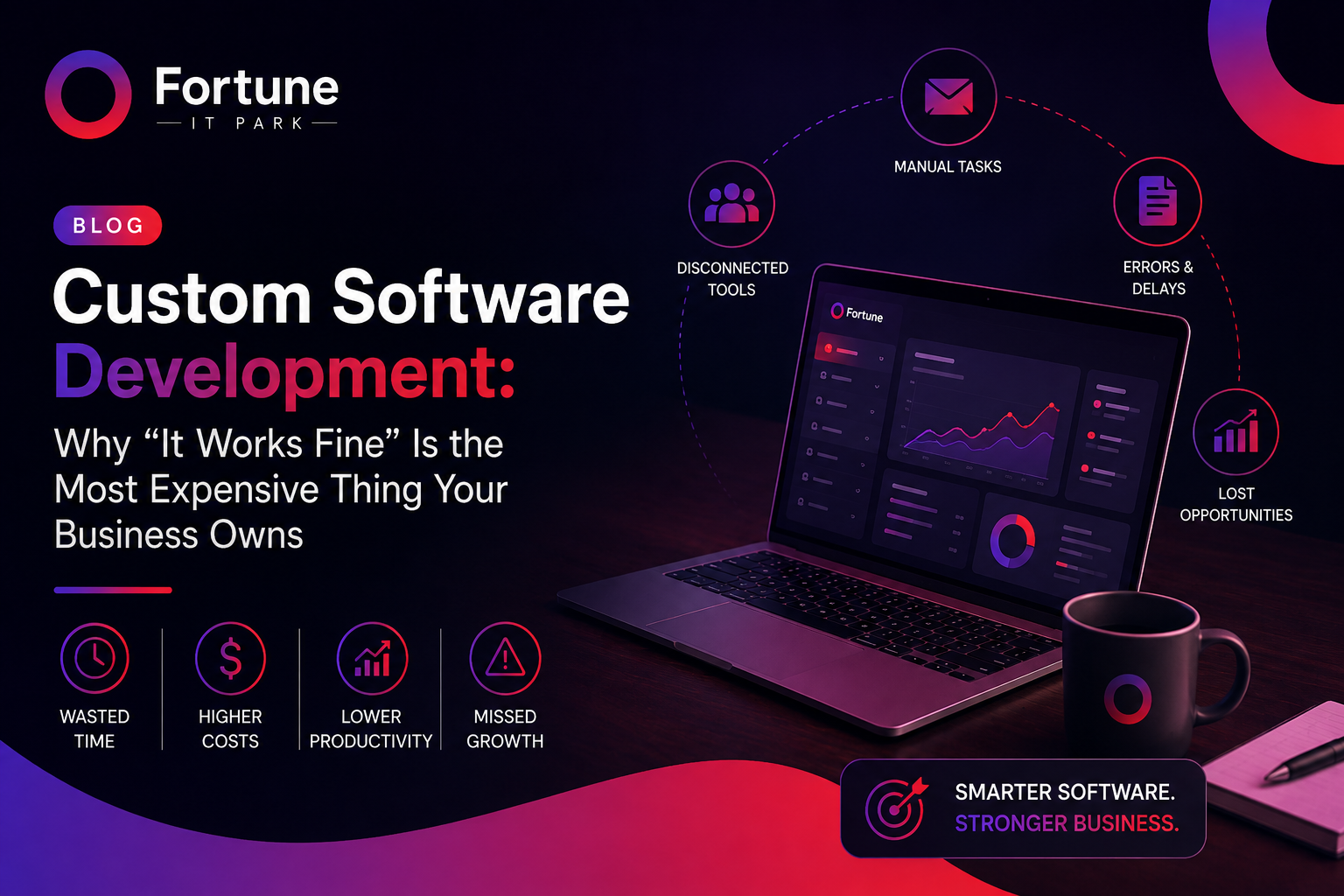
Nobody looks at their software subscription bill and thinks “this is bankrupting us.” The cost of settling for “good enough” doesn’t show up on an invoice. It shows up somewhere quieter.
We see it most often in five places.
The tool does 80% of what you need, and you’re paying for the other 20% you’ll never get. Off-the-shelf platforms are priced to satisfy their most demanding customer while being built for their average one. You end up carrying features you’ll never touch, and missing the one that would’ve actually made a difference.
Someone on your team has become the human patch for your software. Every business we’ve worked with has one — a person with a personal spreadsheet, a manual double-check, a “just send it to me and I’ll handle it” step that quietly holds the whole process together. That’s not a people problem. That’s your software telling you it’s not actually doing its job.
Your tools don’t talk to each other, so your team does the talking for them. Data gets copied from the CRM into the accounting tool by hand. Someone re-types the same customer information into three different systems in the same week. Every one of those manual handoffs is a place where something eventually goes wrong.
You’ve outgrown the platform, but switching feels riskier than staying. This is the trap. Migrating feels disruptive, so businesses stay a year, then two, quietly working around limitations that are getting more expensive with every month they’re tolerated.
The one thing that actually differentiates your business isn’t something generic software was built to support. If your edge is a specific process, a specific way you handle customers, a specific workflow that’s genuinely yours — a platform built for everyone can’t give you that. It wasn’t designed to.
None of these are catastrophic on their own. Together, they’re the difference between a business that scales cleanly and one that hits a ceiling it can’t quite explain.
How to Tell If You’re Ready for Custom
We ask clients a version of the same questions before any project starts, because the answer to “should we build custom” usually reveals itself pretty fast:
- Are you running multiple tools that were never designed to work together, just patched into a workflow?
- Has your team built manual workarounds to make the current setup usable?
- Have you asked a vendor for something specific and been told it’s “not on the roadmap”?
- Is the process you’re trying to support actually part of what makes your business different — not just generic operations?
- Is per-seat or per-user pricing starting to punish you for growing?
- Are you building something you intend to sell, not just something to run your own operations?
If two or more of those land, it’s worth at least scoping what custom would look like — even if the answer ends up being “not yet.” A scoping conversation costs you an hour. Staying on the wrong system for another year costs a lot more.
What Changes When Businesses Actually Make the Switch
The specifics are different every time, but the shape of the change is almost always the same. Teams that were re-entering the same data into three systems stop doing that entirely. Reports that used to take half a day to compile start generating themselves. Sales teams stop losing deals to slow follow-up because the system finally tracks what it’s supposed to track. Customer support stops drowning in the same repeat questions because a portal now answers them automatically.
None of that is a dramatic before-and-after story — it’s just friction disappearing, week after week, until someone on the team eventually says “how did we used to do this manually?”
(We’re keeping this section general for now rather than inventing client names or numbers we can’t back up. Once you’ve got a project or two you’re happy sharing publicly, swap this for 1–2 real examples with real results — that will outperform generic claims by a wide margin for both SEO and trust.)
How We Actually Build It
We don’t open with a tech stack conversation. We open with how your business runs today, because software built without that context tends to solve the problem someone described instead of the problem that’s actually there.
- Discovery. We map your current process — the tools, the workarounds, the bottlenecks nobody’s said out loud yet. This is usually where the real scope of the project becomes clear, and it’s often different from what the initial ask sounded like.
- Architecture & design. We design around how your team actually works and how the business needs to scale, not around a template that happens to be flexible enough to sell to everyone.
- Build & integrate. We build the system and connect it into what you’re already running, so your team isn’t relearning everything on day one — they’re getting the parts that were broken fixed.
- Test against real use, not a checklist. Software that passes a QA checklist and software that survives actual daily use by your team are two different things. We test for the second one.
- Support it as your business changes. A custom build isn’t a one-time delivery. Businesses evolve, and the software needs to evolve with them — which is often where staff augmentation or workflow automation comes in as the next step, once the core system is solid.
Custom Software vs. Off-the-Shelf: The Honest Comparison
| Off-the-Shelf Software | Custom Software | |
|---|---|---|
| Fit to your process | Built for the average customer | Built for your exact workflow |
| Upfront cost | Lower | Higher |
| Long-term cost | Grows with per-seat pricing as you scale | Fixed investment, no recurring licensing bloat |
| Flexibility | Limited to the vendor’s roadmap | Changes when your business needs it to |
| Integration | Often limited, sometimes costly add-ons | Built to connect exactly where you need it |
| Competitive edge | The same tool your competitors are using | Built around what actually makes you different |
To be clear — this isn’t a case for custom software being the right answer for everyone. If your process is genuinely standard, an off-the-shelf tool is often the faster, cheaper, and smarter choice. Custom makes sense when your business has outgrown what a generic tool was ever meant to handle, not before.
Questions We Get Asked Before Every Project
How much does custom software development actually cost? Honestly, it depends on scope in a way that makes a fixed price list dishonest. A focused internal tool is a very different investment from a full customer-facing SaaS platform. We quote after a discovery call, once we know what’s actually being built.
How long does a custom build take? A single, well-scoped internal tool can often be live within weeks. Larger platforms with multiple integrations or a public-facing product take longer — we scope realistic timelines during discovery so there are no surprises halfway through.
Is this actually worth it for a small or mid-sized business, or is it just for enterprises? It’s worth it once you’re paying for multiple overlapping tools or your team is running manual workarounds to make software usable. If your process is standard and an existing tool covers it well, custom isn’t necessary yet — and we’ll tell you that.
What’s the difference between custom software and building a SaaS product? Custom software is usually built for one business’s internal use. A SaaS product is custom-built software meant to be sold to many customers. We build both — internal tools that fix operational friction, and full SaaS platforms for businesses building something to sell.
Do you work with companies outside the US? Yes. We build custom software, CRMs, and internal platforms for clients across the US, UK, and Middle East.
The Bottom Line
Off-the-shelf software isn’t the villain here. For a lot of businesses, it’s exactly the right tool. But there’s a point where “it works fine” starts quietly costing more than it’s saving — in hours, in mistakes, in the ceiling it puts on how fast you can actually grow.
If your team is spending more time working around your software than working with it, that’s usually the clearest sign it’s time to have a real conversation about building something custom.
Want an honest read on whether custom software makes sense for where you are right now? Book a free strategy call with Fortune IT Park and we’ll tell you straight, even if the answer is “not yet.”